





Can you take moringa powder while pregnant?

Do not start moringa powder while pregnant without your prenatal clinician reviewing the exact product; there is no established pregnancy-safe supplement dose. Moringa leaf powder, tea, and concentrated extracts are not interchangeable, and traditional food use does not establish supplement safety. This 2026 guide explains the evidence, label details, and questions that matter before you take it.
- Taking moringa while pregnant requires prenatal clinician review; no established pregnancy-safe supplement dose exists.
- Moringa oleifera leaf powder, leaf tea, and concentrated extracts are different preparations, not interchangeable prenatal options.
- MotherToBaby cautions that many herbal products lack adequate pregnancy research; natural does not mean pregnancy-safe.
- Do not replace your prenatal vitamin, prescribed iron, or medical care with moringa leaf supplements.
Can you take moringa powder while pregnant?
Do not self-prescribe moringa powder during pregnancy. Ask your obstetrician, midwife, or prenatal pharmacist to review its ingredients, plant part, preparation, and intended use before you start.
MotherToBaby’s Herbal Products fact sheet explains that many herbal products have not been adequately studied during pregnancy. It also identifies concerns about variable ingredients, strength, and possible contaminants. That guidance supports caution; it does not establish a safe moringa serving.
Moringa’s reputation as a nutrient-containing plant does not settle the pregnancy question. A product needs evidence relevant to its preparation, amount, and users—not just a history of use or a list of nutrients.
For background on purchasing claims, the guide to whether organic moringa powder is worth it addresses a separate decision. Organic certification and pregnancy suitability are different questions.
| Preparation | What you are consuming | Useful distinction | Pregnancy limitation |
|---|---|---|---|
| Leaf powder | Dried, ground moringa leaves | Identifies the leaf as the plant part | Does not establish a pregnancy-safe serving |
| Leaf tea | An infusion made from moringa leaves | Preparation differs from swallowing leaf powder | A cup is not a standardized supplement dose |
| Leaf extract | An extracted preparation of the leaves | The label identifies a different preparation | Powder research cannot automatically establish extract safety |
| Root or bark preparation | Different parts of the moringa plant | Must be distinguished from leaf products | Leaf information cannot establish root or bark safety |
None of these preparations is recommended here as a prenatal supplement. The table helps you identify what needs review, not choose a supposedly safer alternative.
Why this matters
Pregnancy changes the decision you are making. You are not simply choosing a convenient source of plant nutrients; you are considering an exposure whose safety must be assessed for you and your pregnancy.
A familiar ingredient can still have unanswered questions in supplement form. Likewise, the absence of a warning on a label is not evidence that researchers have established safety.
Use pregnancy-specific evidence, not general wellness claims, to make the decision. An energy, digestion, or immune-support description does not answer whether you should take that product while pregnant.
What does the research actually tell you?
The useful distinction is between evidence of a possible nutritional benefit and evidence of pregnancy safety. Those are separate questions, and one cannot stand in for the other.
Traditional use is context, not a safety finding
Moringa leaves have a history of food use. That history explains why people ask about the plant, but it does not establish the safety of every powder, capsule, tea, or extract during pregnancy.
Your clinician needs to know whether you mean cooked leaves in a meal or a daily supplement. Calling both products moringa hides differences that matter to the assessment.
Breastfeeding research does not answer pregnancy questions
The National Library of Medicine’s LactMed entry on moringa discusses its use during lactation, including research on milk production. Lactation evidence addresses a different stage of care and cannot establish safety during pregnancy.
A study involving breastfeeding parents is not a prenatal safety study. Check who actually participated before applying a headline about moringa to your own situation.
General supplement rules are not pregnancy approval
The FDA’s dietary supplement guidance explains that supplements are not approved for safety and effectiveness before marketing in the way medicines are. A product being sold does not mean the FDA has cleared it for pregnant users.
For your 2026 decision, separate the seller’s product description from the evidence your prenatal clinician needs. Neither a familiar brand nor a detailed label closes an unanswered pregnancy-safety question.
Why advice about moringa during pregnancy varies
Conflicting answers often reflect different products or different questions. These distinctions explain why a general recommendation is not enough:
- Plant part: Leaf information does not establish the safety of roots, bark, or mixed plant parts.
- Preparation: Ground leaves, brewed tea, and extracts are different exposures; their serving instructions are not interchangeable.
- Amount and frequency: An occasional food ingredient is a different use pattern from a regularly measured supplement.
- Other ingredients: A single-herb product and a multi-herb blend require different ingredient reviews.
- Your care plan: Your medicines, supplements, medical history, and reason for taking moringa belong in the assessment.
- Research population: Findings in nonpregnant adults or breastfeeding parents do not automatically apply to pregnancy.
These factors explain uncertainty; they do not supply a formula for calculating your own safe dose. In 2026, use the exact label and your prenatal care plan as the starting point for a professional review.
How should you check a moringa product before taking it?
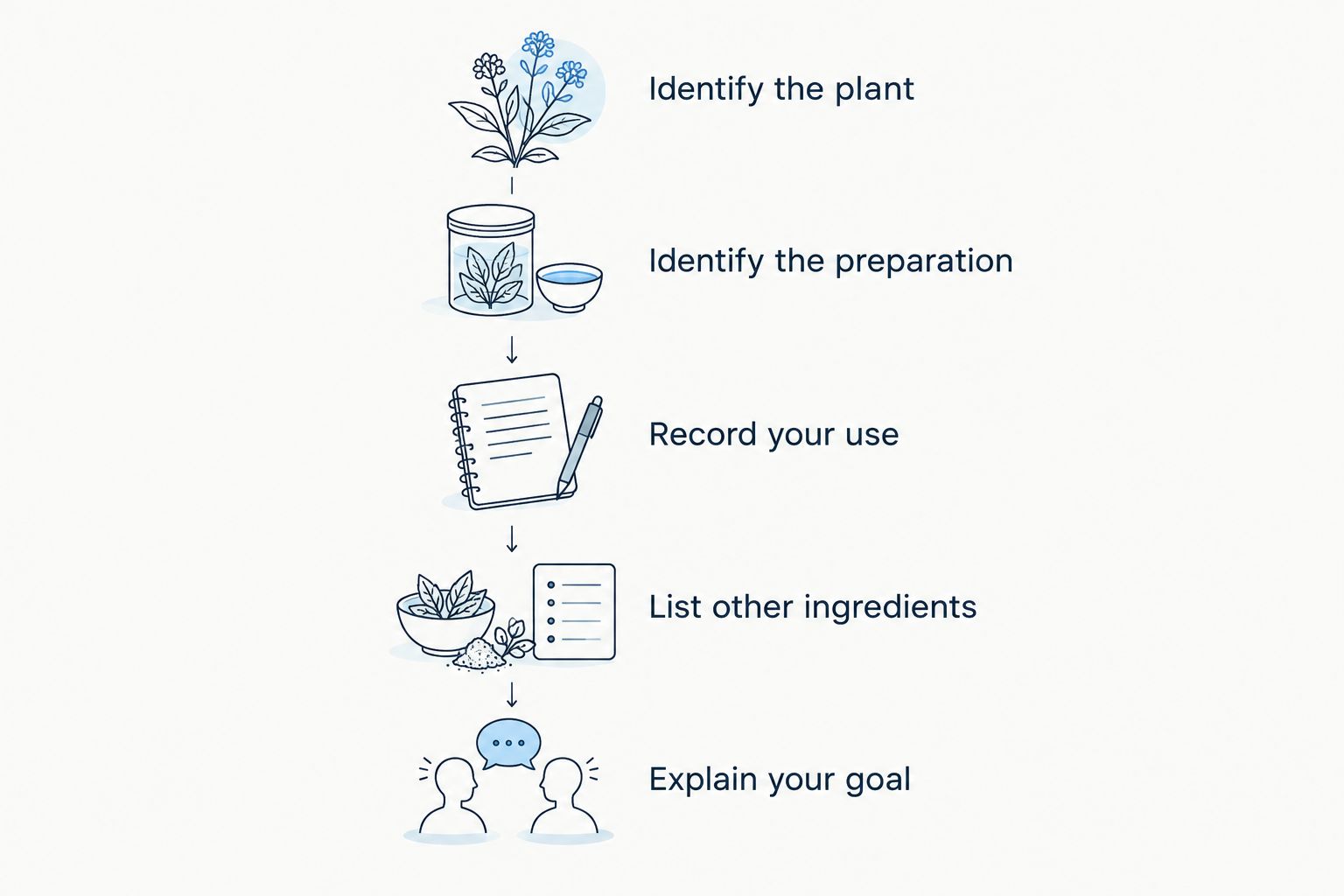
Bring the container or clear photographs of the complete label to your prenatal appointment. A product name alone leaves too much out.
- Identify the plant. Look for Moringa oleifera and the plant part used. If the plant part is unclear, ask the manufacturer rather than assuming it is leaf.
- Identify the preparation. Record whether the product is powder, tea, capsules, or liquid extract. Include any concentration wording exactly as printed.
- Record your use. Write down the labeled serving, how much you intended to take, and how often. If you already used it, record what you actually took.
- List other ingredients. Include additional herbs and other listed ingredients, not just the ingredient named on the front.
- Explain your goal. Tell your clinician whether you are seeking nutritional support, help with tiredness, or something else. The underlying concern deserves its own assessment.
Ask for a clear decision about that specific product. If your clinician advises against it, do not substitute a tea or another extract without asking; changing the form does not resolve the original safety question.
Can moringa replace a prenatal vitamin or prescribed iron?
No. Moringa is not a substitute for your prenatal vitamin or prescribed iron. Its nutrient reputation does not show that your serving supplies the nutrients your care plan requires.
The NIH Office of Dietary Supplements lists these daily pregnancy recommendations for adults:
- Folate: 600 micrograms dietary folate equivalents daily. Dietary folate equivalents account for differences between forms of folate.
- Iron: 27 milligrams daily. Your clinician can recommend a different treatment plan when your individual needs require it.
- Calcium: 1,000 milligrams daily for pregnant adults. Pregnancy recommendations differ for adolescents.
These are total daily intake recommendations, not instructions to take each amount as an additional supplement. Your diet, prenatal product, and clinician’s advice determine how you meet them.
A spoonful of moringa is not evidence that you have met those targets. Do not stop a prescribed supplement because a powder is described as nutrient-dense, and do not use moringa to manage abnormal blood-test results yourself.
Is moringa tea safer than powder during pregnancy?
Moringa tea is not automatically safer than moringa powder during pregnancy. Brewing changes the preparation, but it does not create a validated pregnancy-safe serving.
For example, Herbal Goodness lists a Moringa Leaf Tea. Identifying it as leaf tea tells you the preparation; it does not establish that pregnant shoppers should use it.
For pregnant shoppers, Herbal Goodness moringa products require the same prenatal review as other herbal supplements. Clear plant and preparation details help that review, but they do not replace pregnancy-specific evidence.
This distinction also matters if you sell supplements or advise clients. Describe the product accurately without translating general wellness wording into a prenatal recommendation.
What if you already took moringa while pregnant?
Taking moringa does not, by itself, establish that harm occurred. Do not assume the worst, but do not use the absence of immediate symptoms as proof of safety either.
Contact your prenatal clinician with the product name, complete ingredient list, amount, timing, and any symptoms. Keep the packaging so the clinician can assess the actual exposure rather than a guessed preparation.
Do not take another serving while waiting for advice. If you have vaginal bleeding, severe abdominal pain, fainting, or another urgent pregnancy concern, seek prompt medical care rather than waiting for a supplement discussion.
Is moringa safe later in pregnancy?
There is no established pregnancy-safe supplement dose that becomes applicable simply because you enter a later trimester. A recommendation made for someone else—or for a different stage of pregnancy—is not your personal clearance.
Tell your clinician how far along you are and whether your medicines or care plan have changed. Treat pregnancy timing as part of the assessment, not a reason to bypass it.
FAQ
Can I take moringa while pregnant in 2026?
Do not start moringa while pregnant without your prenatal clinician reviewing the exact product. There is no established pregnancy-safe supplement dose, and powder, tea, and extracts are not interchangeable.
How much moringa powder is safe during pregnancy?
No established pregnancy-safe moringa powder dose is available. A serving printed on a supplement label is not a pregnancy-specific dosing recommendation.
Is organic moringa powder safe for pregnant women?
Organic certification does not establish pregnancy safety. Your prenatal clinician still needs to review the plant part, preparation, ingredients, and intended use.
Can I drink moringa leaf tea instead of taking capsules?
Switching to moringa leaf tea does not establish safety during pregnancy. Ask your prenatal clinician to assess the tea itself rather than treating it as an approved substitute.
Can moringa replace my prenatal vitamin?
Moringa cannot replace your prenatal vitamin or prescribed supplements. Follow your prenatal care plan instead of assuming a plant powder supplies the required nutrients.
Does moringa breastfeeding research mean it is safe during pregnancy?
Breastfeeding research does not establish moringa safety during pregnancy. The National Library of Medicine’s LactMed entry addresses lactation, which is a different clinical question.
What should I do if I already drank moringa tea while pregnant?
Contact your prenatal clinician with the tea’s ingredients, the amount you drank, and when you drank it. An exposure does not by itself establish harm; seek prompt care for urgent symptoms such as bleeding or severe abdominal pain.
One last thing
The most useful detail is often the preparation, not the plant name. A photograph showing the complete label gives your clinician more to assess than a message asking whether moringa is safe.
For your 2026 prenatal visit, bring the product details and the reason you wanted to take it. Apply that same standard to Herbal Goodness supplements and every other brand: identify the product first, then make the pregnancy decision with your clinician.