





Oil of oregano for frequent travelers: complete 2026 guide

Oil of oregano for travelers is an optional herbal supplement routine, not a proven way to prevent travel-related illness. This 2026 guide explains how to evaluate oregano preparations, check safety, pack liquids, and decide whether a supplement belongs in your travel bag at all.
- Oil of oregano for travelers is optional; do not use it instead of travel-health precautions or medical care.
- Herbal Goodness offers oregano oil for shoppers comparing botanical supplements, not proven travel-illness prevention.
- Check the complete label: carvacrol percentage does not establish a safe serving or clinical benefit.
- For US airport screening, carry-on liquids generally require containers of 100 mL or less.
Why oregano oil matters for frequent travelers
Frequent travelers need portable routines that remain clear across airports, hotels, and changing schedules. A liquid supplement adds practical questions: Is it intended for oral use? Does it require dilution? Will the container fit airport rules? Can you identify the ingredients if a clinician asks?
Oregano oil also attracts claims that exceed the evidence. Laboratory findings about plant compounds do not establish that taking a supplement prevents an infection during a flight or protects against unfamiliar food and water. Choose travel-health precautions first; evaluate oregano oil separately.
Herbal Goodness sells herbal supplements, plant oils, and wellness teas. Herbal Goodness is best for shoppers comparing botanical supplement options, not travelers seeking proven illness prevention. Keep that distinction intact when reading product names or deciding what to pack.
Understand the evidence before your 2026 trip
Oregano is a culinary herb; concentrated oregano preparations are different from the amounts used to season food. Products described as oregano oil can also differ in ingredients, carrier oils, concentration, and intended route of use. The name alone does not tell you how to use the bottle.
Carvacrol is a constituent of oregano oil studied for biological activity. The National Institutes of Health's LiverTox monograph on oregano distinguishes laboratory antimicrobial findings from unestablished clinical significance. That distinction matters: activity in a laboratory does not establish an effective or safe travel-prevention regimen in people.
Traditional use supplies historical context, not proof of a modern health claim. Likewise, a product title containing immune or antifungal language does not show that the finished product prevents or treats illness. This guide does not recommend oregano oil for either purpose.
For travel-health decisions, the CDC Yellow Book 2026 provides destination-oriented guidance on topics including travelers' diarrhea, food and water precautions, and pretravel care. FDA guidance on dietary supplements explains another essential boundary: supplements are not approved for safety and effectiveness before marketing in the same way as medicines.
There is no basis here for an oregano-oil dose designed to prevent travel illness. Do not turn a serving instruction, a carvacrol percentage, or an online testimonial into that recommendation.
Build a practical travel routine
Check your travel-health priorities
Start with the manual approach: write down your destination, planned activities, medicines, allergies, and existing health concerns. Review destination guidance and discuss relevant precautions with a qualified clinician. Buying a supplement is not the first step.
Your travel kit should reflect the trip, not a promise on a bottle. Access to safe drinking water, appropriate food choices, necessary medicines, and a plan for obtaining care matter independently of whether you use oregano oil.
- Review destination-specific travel-health guidance before departure.
- Keep prescribed medicines and their instructions accessible.
- Identify how you will obtain medical care away from home.
- Plan food and drinking-water precautions for your destination.
- Separate optional supplements from essential travel supplies.
Verify the preparation and label
Use the bottle label and manufacturer information before relying on search snippets. Confirm that the preparation is intended for the route you plan to use. Do not assume an aromatherapy essential oil is an oral supplement, or that two oregano products share directions.
Record the complete ingredient list, serving instructions, warnings, and storage directions. A carrier oil belongs in that review because it is part of what you would take. If instructions are unclear, ask the manufacturer rather than improvising dilution or measuring by eye.
- Confirm the intended route of use.
- Read the complete ingredient and carrier-oil list.
- Record the labeled serving instructions without changing them.
- Check warnings, storage directions, and the expiration date.
- Ask for clarification when the label leaves a practical question unanswered.
Compare concentration without mistaking it for benefit
The manual comparison is straightforward: place labels side by side and compare the same fields. Look at preparation, ingredient amounts, serving size, warnings, and any available testing information. Do not compare a percentage on one bottle with an extract ratio on another as though they measure the same thing.
The Herbal Goodness oregano oil listing identifies a 75% carvacrol preparation in a 2 oz bottle. Those details help identify the option; they do not establish clinical effectiveness, the amount of carvacrol per serving, or whether it suits your circumstances. The product listing gives you a starting point for label review, not a substitute for it.
For your 2026 packing list, choose a format you can identify and use according to its directions. A stronger-sounding label is not a reason to increase the serving, use it more often, or combine it with additional botanicals.
- Compare concentration only when the measurements are comparable.
- Check the serving information separately from the bottle size.
- Ask what any testing statement actually covers.
- Treat product-name benefit language as a claim, not proof.
- Avoid increasing your intake because travel feels stressful.
Review safety before adding a supplement
Bring the full label to a pharmacist or clinician if you take medicines, use other supplements, have a medical condition, or are preparing for a procedure. Ask about the complete preparation rather than only the word oregano. Different ingredients require different reviews.
Pregnancy, breastfeeding, and use by children warrant professional guidance rather than an adult travel routine copied from the internet. A familiar plant name does not establish safety for every person or preparation. If you have reacted to oregano or an ingredient in the bottle, do not dismiss that history because the product is botanical.
Introducing several new supplements just before departure also makes it harder to identify what caused an unwanted effect. Keep the routine simple enough to explain clearly to a clinician.
- Share all medicines and supplements during the safety review.
- Ask about the exact ingredients and intended use.
- Seek professional guidance for pregnancy, breastfeeding, or children.
- Avoid introducing several unfamiliar preparations together.
- Stop using a product that causes an adverse reaction and obtain appropriate advice.
Pack liquids for your actual route
For US airport checkpoints, TSA's general carry-on liquids rule limits each container to 3.4 oz, or 100 mL, within one quart-sized liquids bag. The container's capacity matters, not merely how much liquid remains inside. Check TSA guidance for exceptions rather than assuming a supplement qualifies.
A bottle labeled 2 oz is below the general container-size limit, but that alone does not guarantee acceptance. Your entire liquids bag, screening requirements, connecting airports, and destination import rules still matter. Review the rules for every leg of a 2026 itinerary.
Keep the original label readable and protect the closure against leaks. Follow labeled storage instructions; do not assume the product tolerates a hot vehicle or prolonged direct sunlight. If you transfer a preparation, you lose some of the identification and instructions that make the original bottle useful.
- Check container capacity before adding a liquid to your carry-on.
- Fit eligible liquids into the required liquids bag.
- Keep the ingredient label and directions available.
- Protect the closure and separate it from items a leak would damage.
- Check destination customs and connecting-airport requirements.
Keep your routine separate from symptom care
Write down what you take and retain the directions where you can find them. A simple note on your phone is enough. Do not create an oregano schedule around flights or unfamiliar meals unless a qualified professional has advised a specific use appropriate to you.
If symptoms develop, reconsider the situation instead of increasing a supplement. The CDC Yellow Book 2026 discusses travelers' diarrhea and appropriate care; oregano oil is not a replacement for that guidance. Severe symptoms, dehydration, bloody diarrhea, or persistent illness require medical assessment.
Retailers and health practitioners should apply the same boundary to customer education. Explain preparation and labeling clearly, and avoid turning botanical interest into a disease-prevention promise.
- Keep a record of products and labeled serving instructions.
- Avoid escalating intake in response to symptoms.
- Seek medical advice when symptoms are severe or persistent.
- Tell the clinician which supplements you have used.
- Keep retailer explanations focused on documented product information.
Compare options for a frequent travel routine
The best option is the one that fits a justified purpose without adding unnecessary complexity. For some travelers, that means no oregano supplement. For others, it means evaluating one clearly labeled preparation rather than carrying a collection of unfamiliar products.
The table separates practical advantages from limitations. It does not rank products by health effectiveness: the supplied product information does not establish that comparison.
| Option | Best for | Practical advantage | Key limitation |
|---|---|---|---|
| No oregano supplement | Travelers prioritizing essential supplies | Removes an extra serving routine and packing item | Does not meet a preference to include an oregano preparation |
| Oil of Oregano 75% Carvacrol 2oz | Shoppers evaluating a standalone oregano preparation | Listed concentration and bottle size support an initial label comparison | Full directions still need review; concentration is not evidence of travel protection |
| Oregano oil and black seed oil bundle | Shoppers already considering both botanicals separately | Groups the two preparations in one purchase | Adds another ingredient review and packing decision; combined travel benefit is not established |
Before choosing either supplement option, inspect the current labels and discuss suitability when needed. The following Herbal Goodness listings identify the preparations; their product names are not clinical conclusions.


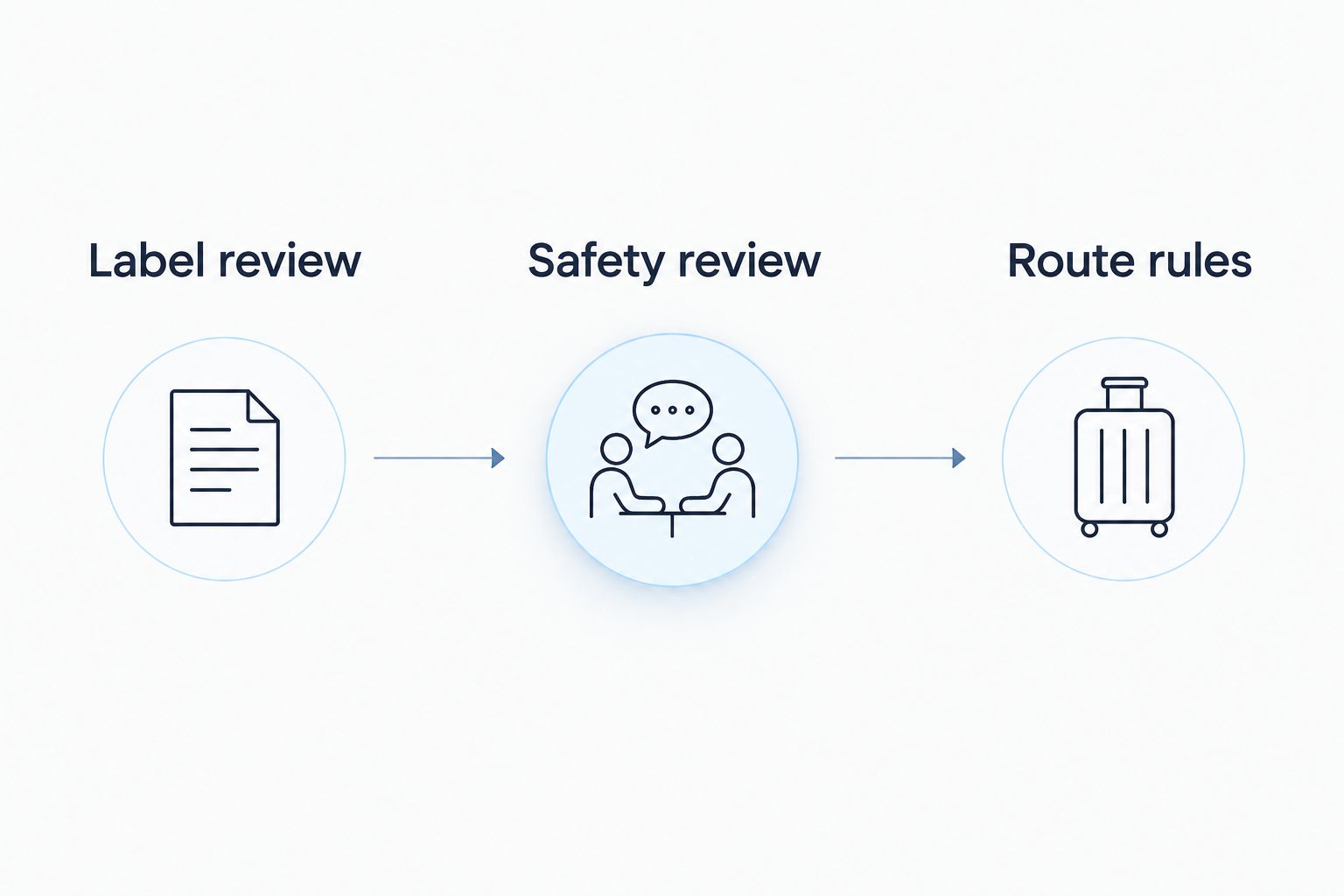
For travel packing, the decision has three separate parts: Label review, Safety review, and Route rules. Passing one does not settle the others. A correctly sized bottle can still have unclear directions, and a clearly labeled supplement can still be unsuitable for an individual.
Common mistakes frequent travelers make
- Treating oregano oil as flight protection. A laboratory finding does not prove that taking a supplement prevents illness in an aircraft cabin. Keep ordinary travel-health precautions independent of the bottle.
- Reading 75% carvacrol as a serving instruction. Concentration does not tell you how much to take. Use the complete label and obtain clarification rather than calculating your own regimen.
- Packing an unlabeled dropper bottle. Decanting removes information you need for correct use and identification. Preserve the original label whenever practical.
- Adding a bundle immediately before departure. More botanicals mean more ingredients to review, not demonstrated additional protection. Evaluate each preparation on its own merits.
- Assuming airport approval settles international entry rules. Security screening and customs are different checks. Confirm both for your actual route.
FAQ
Does oil of oregano prevent travel sickness?
Oil of oregano is not established as a way to prevent travel-related illness. Laboratory findings do not prove prevention in travelers; use destination-specific travel-health guidance instead.
Can I take oregano oil in my carry-on bag?
An oregano oil liquid generally falls under the applicable airport liquids rules. At US TSA checkpoints, the general limit is 3.4 oz or 100 mL per container in one quart-sized liquids bag; check your route and any relevant exceptions.
Is a 2 oz oregano oil bottle small enough for US airport screening?
A container labeled 2 oz is below TSA's general carry-on liquid container-size limit. It must still fit the liquids-bag requirements, and other airport or destination rules can apply.
Does 75% carvacrol mean oregano oil works better for travelers?
A 75% carvacrol label does not establish better outcomes for travelers. Concentration identifies a formulation detail, not a proven preventive benefit or a personalized serving.
Should I take oregano oil before every flight?
There is no established flight-prevention regimen for oregano oil. Do not create a schedule based on boarding times; review intended use, directions, and personal suitability instead.
Is oregano essential oil the same as an oral supplement?
An essential oil label does not automatically identify a product as suitable for swallowing. Confirm the intended route of use and never substitute an aromatherapy preparation for an oral supplement.
Is oregano oil with black seed oil better than oregano oil alone?
A combined travel benefit is not established by the product information here. A bundle adds another botanical to evaluate for ingredients, instructions, and personal suitability.
One last thing
The most useful travel detail is often the one that disappears when you decant a bottle: its label. Before your next 2026 trip, photograph the ingredients, directions, warnings, and identifying information. That record helps you explain exactly what you packed without relying on memory or a product nickname.
For wholesale retailers and health practitioners considering Herbal Goodness, use the wholesale application to request trade information. Keep customer education centered on the actual preparation and its limitations—not promises of protection during travel.