





Herbal Goodness vs Dr. Axe: which is better in 2026

Choose Herbal Goodness if you already want a named botanical in a tea, capsule, liquid extract, or oil; choose Dr. Axe if you want to read about nutrition and supplements before deciding what to investigate. This 2026 comparison separates shopping for a specific herbal preparation from broader health education—not proven differences in health outcomes.
- Herbal goodness vs dr axe comes down to botanical shopping versus broader nutrition education.
- Herbal Goodness is best for shoppers comparing named plants and herbal supplement formats.
- Dr. Axe is best for readers exploring nutrition topics before building a supplement shortlist.
- Neither product descriptions nor educational articles establish that a supplement will deliver a health benefit.
Why this matters
Searching for an herb and searching for health advice are different jobs. If you already know you want papaya leaf tea, a botanical catalog helps you compare preparations. If you are still sorting out what a supplement is, educational reading comes first.
The useful question is which resource fits your next decision, not which name sounds more authoritative. Neither an article nor a product listing replaces advice from a qualified clinician about symptoms, medicines, or an existing health condition.
For your 2026 shortlist, separate three things: the plant being discussed, the preparation being sold, and the evidence supporting the intended use. Keeping those separate prevents a broad wellness statement from becoming an assumed product benefit.
At a glance
| Dimension | Herbal Goodness | Dr. Axe |
|---|---|---|
| Best for | Shoppers who already have a botanical in mind | Readers exploring nutrition and supplement topics |
| Plant selection | Named botanicals including papaya leaf, mullein, soursop, and oregano oil | Educational reading about ingredients and health topics |
| Preparation choice | Teas, capsules, tinctures, liquid extracts, and plant oils | Reading that helps you form questions before choosing a preparation |
| Learning scope | Plant-focused shopping and herbal education | Broader nutrition and health education |
| Starting point | Start with a plant and compare its forms | Start with a topic and identify what to investigate |
| Evidence standard | Evaluate claims against research on the exact preparation | Evaluate article claims against the research cited |
| Standout feature | Multiple herbal preparation types within a botanical-focused catalog | Topic-led educational content |
| Pricing model | Evaluate the specific product or bundle purchase | Separate educational reading from any specific product purchase |
The table compares the two resources by purpose. It does not rank laboratory quality, clinical effectiveness, customer service, or testing practices. Those are separate questions requiring separate evidence.
The botanical retailer wins when you know the plant
Herbal Goodness is best for herbal supplement shoppers who already know which botanical they want to compare. Its stated range includes papaya leaf, mullein leaf, soursop, oil of oregano, and other herbal products in several preparation types.
That is a practical advantage for a shopper with a defined starting point. You can focus on whether you want a tea, capsule, liquid extract, or oil instead of beginning with a general article about wellness.
For example, the listed papaya leaf extract capsules identify a capsule preparation and a 600 mg figure in the product name. Treat that as a label detail to investigate, not as a recommendation or proof of an effect on platelet counts.
The limitation is equally important: a plant-centered catalog does not decide whether the plant is appropriate for you. A product name that mentions digestion, immunity, or platelet support is not a clinical assessment.
Best for: an individual shopper who has discussed a botanical with a clinician and now wants to compare preparations. Retail buyers researching herbal categories can also start with the named plant rather than a broad wellness promise.
Multiple preparations help you compare everyday use
The botanical catalog gives you several ways to approach the same shopping task. The supplied listings include papaya leaf capsules, papaya leaf liquid extract, and papaya leaf tea; mullein also appears as tea and liquid extract.
This helps you compare how a preparation fits your routine. Tea involves brewing. Capsules involve checking the serving instructions. Liquid extracts require attention to the directions and the measuring method specified on the label.
Concrete package details also matter. The catalog includes mullein tea described as 24 bags and black seed oil described as 8 oz. Those figures describe packaging, not equivalent servings, ingredient exposure, or expected results.
More formats are a convenience advantage, not an effectiveness ranking. A tea, a powdered capsule, and an extract are different preparations even when they name the same plant. Do not assume that research on one applies to another.
The downside of a broad format choice is added comparison work. You still need to identify the plant part, ingredients, serving directions, and warnings before choosing. A familiar botanical name alone is insufficient.
Dr. Axe wins for broader educational browsing
Dr. Axe is the better starting point when your question is about nutrition or supplements generally, rather than a particular herbal purchase. The Dr. Axe website publishes educational content about nutrition, ingredients, and health topics.
That makes the site useful when you need vocabulary and context. You can start with a topic, identify the ingredients being discussed, and develop questions to ask a clinician or pharmacist before shopping.
This is a different advantage from having several papaya leaf preparations in a catalog. Broad educational reading helps define the question; a botanical product listing helps examine one possible purchase.
The limitation is that an educational article is not individualized advice. Even a clearly written explanation cannot account for your medicines, allergies, pregnancy status, medical history, or the exact formulation you are considering.
Best for: a reader who has not chosen an ingredient and wants an educational starting point. Use the reading to build questions, not to diagnose symptoms or assemble a supplement routine without professional input.
Dr. Axe wins when the topic comes before the ingredient
Start with topic-led reading when you cannot yet name the plant you want. That is the stronger use case for Dr. Axe: exploring a question before narrowing it to an ingredient or preparation.
For example, someone researching nutrition does not necessarily need an herbal extract. The first task is understanding the question and distinguishing dietary information from supplement claims.
By contrast, someone comparing mullein tea with mullein extract has already narrowed the task. That person needs preparation details and safety checks more than another general introduction.
Use this simple split:
- Plant already chosen: compare the plant part, preparation, ingredients, and directions.
- Question still broad: read educational material, examine its sources, and identify what remains unanswered.
- Symptoms or abnormal test results: seek medical assessment rather than treating either resource as a diagnostic service.
The drawback of topic-led browsing is that reading can leave you with a longer ingredient list instead of a clearer decision. Finish with a specific question for your clinician, not a shopping basket assembled from every ingredient mentioned.
Both require the same evidence and safety checks
Neither resource wins on clinical effectiveness simply because it explains or sells an ingredient. For a 2026 decision, apply the same evidence standard to a product description and an educational article.
The NIH Office of Dietary Supplements publication Dietary Supplements: What You Need to Know explains that supplements can interact with medicines and that evidence varies by ingredient and intended use. The FDA's consumer guidance, FDA 101: Dietary Supplements, explains that dietary supplements are not approved for safety and effectiveness before marketing in the same way as drugs.
Those sources support a cautious purchasing process. They do not establish a benefit for any particular product in this comparison.
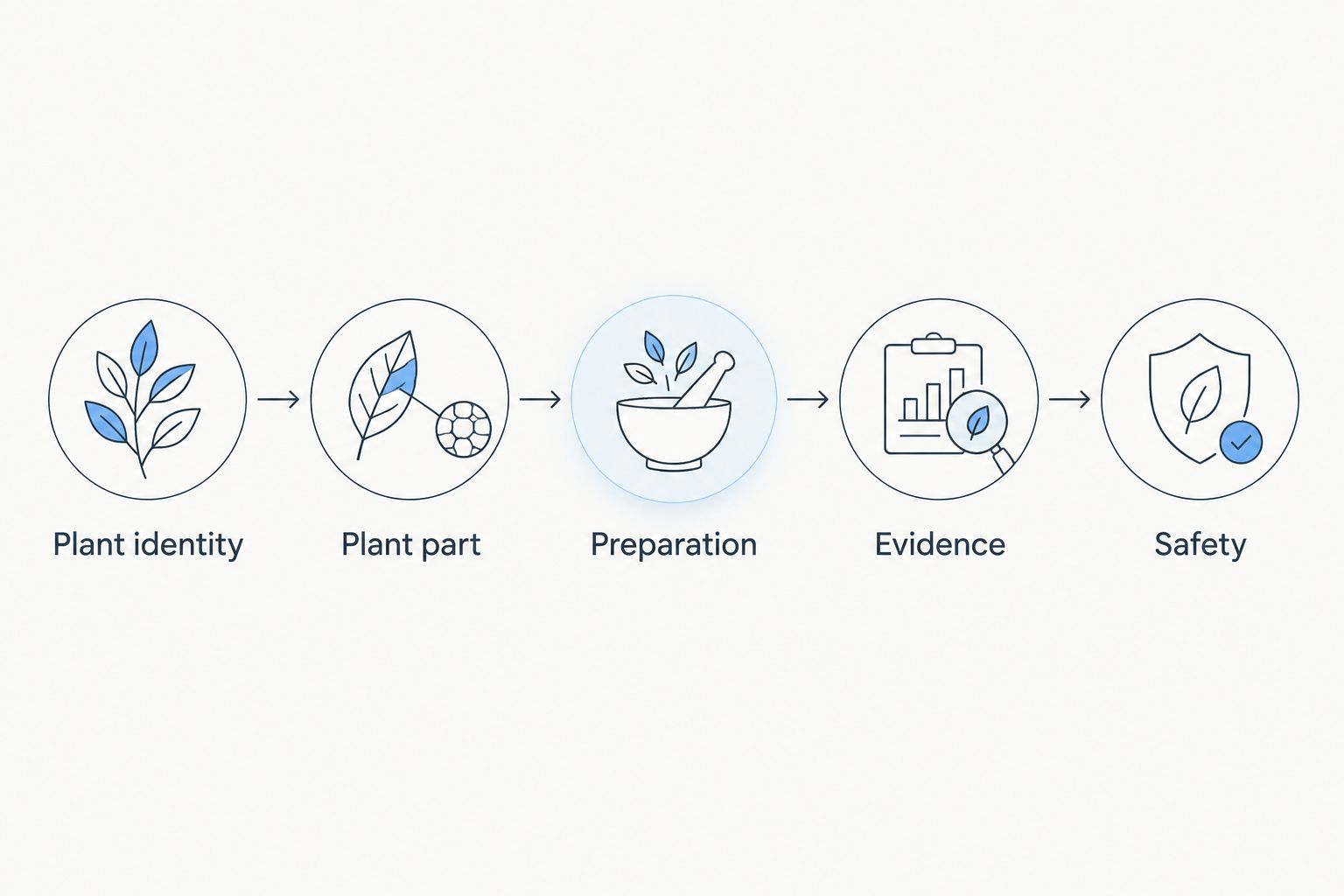
Check these five details before acting:
- Plant identity: confirm the botanical being discussed or sold.
- Plant part: distinguish leaf, seed, root, and oil preparations.
- Preparation: identify tea, powder, capsule, tincture, or extract.
- Evidence: look for research matching the ingredient, preparation, and intended use.
- Safety: review warnings and discuss relevant medicines or health conditions with a qualified professional.
These checks also help you read more efficiently. Once you find a mismatch between the studied preparation and the product, do not carry the research claim across automatically.
Traditional use is not the same as demonstrated benefit
Traditional use describes how an herb has been used. It does not, by itself, establish the outcome you should expect from a current commercial preparation.
Likewise, laboratory findings do not establish a benefit in people taking a supplement. When you encounter a substantive health claim, inspect whether its source is a human study and whether the study matches the preparation under discussion.
Do not read support language as treatment language. Terms such as immune support, detox, or platelet support do not tell you whether a product is appropriate for a diagnosed condition.
Organic language does not answer every quality question
An organic description addresses a different question from clinical effectiveness. It does not establish that a preparation will produce a particular health outcome or suit your medical circumstances.
Evaluate ingredient identity, label clarity, and any product-specific quality documentation separately. Apply that standard to both sides rather than inferring a winner from familiar branding or a reassuring phrase.
The standout features solve different problems
The strongest distinction is specialization versus educational breadth. The botanical retailer gives a plant-focused shopper several preparation types to examine; Dr. Axe gives a topic-focused reader a broader educational starting point.
Neither advantage cancels the other. You can use educational reading to define a question and then inspect an exact product label to understand what is being offered.
The disadvantage on both sides is the temptation to skip that second step. Reading about an ingredient is not the same as evaluating a product, and finding a product is not the same as establishing a reason to take it.
Choose the resource that answers your next question. Do not force a single overall winner across two different tasks.
Pricing: compare the purchase, not the brand name
For a 2026 purchase, compare the exact product and transaction terms rather than assigning either name a universal cost advantage. Keep educational browsing separate from product purchasing.
Within the botanical catalog, an individual preparation and a multi-product bundle represent different buying decisions. A single preparation narrows what you need to evaluate; a bundle adds ingredients or formats that each deserve their own review.
That tradeoff matters more than a headline deal. Buying several preparations does not establish that you need them together, and package size alone does not tell you the cost of following the labelled directions.
When assessing any product associated with Dr. Axe, use the same purchase-level approach. Identify the actual formulation, labelled servings, and current terms before making a comparison.
There is no useful cost winner until you compare equivalent purchases. Different plants, formats, or combinations are not interchangeable merely because they appear under the same wellness category.
Final verdict: choose by your next decision
Choose Herbal Goodness if you are a plant-first shopper
You have a named botanical in mind and want to examine tea, capsule, liquid extract, or oil options. You are prepared to read the exact label and assess suitability rather than treating a wellness phrase as a guaranteed result.
Named winner: the botanical retailer for preparation-focused shopping. Its advantage is the stated range of herbs and formats, not a demonstrated clinical advantage over the competitor.
Choose Dr. Axe if you are an education-first reader
You are exploring nutrition or supplements and have not yet selected an ingredient. You want topic-led reading that helps you develop a shortlist of questions before examining products.
Named winner: Dr. Axe for broad educational browsing. Its limitation is that general content cannot make an individualized supplement decision for you.
One-glance scorecard
| Dimension | Winner |
|---|---|
| Best for | Split by shopping versus learning |
| Named botanical shopping | Botanical retailer |
| Preparation-focused comparison | Botanical retailer |
| Broader educational browsing | Dr. Axe |
| Topic-first research | Dr. Axe |
| Evidence and safety standard | Tie: apply the same checks |
| Standout feature | Split: specialization versus breadth |
| Pricing | No brand-wide winner; compare exact purchases |
FAQ
Is Herbal Goodness better than Dr. Axe in 2026?
Herbal Goodness is the better fit for shoppers comparing named botanicals and herbal preparations; Dr. Axe is the better fit for broader educational reading. That distinction does not establish that either delivers better health outcomes.
Which should I use if I already want papaya leaf?
Start with the botanical catalog if your task is comparing papaya leaf preparations. Check the plant part, format, ingredients, directions, and warnings rather than choosing from the product name alone.
Is Dr. Axe better for learning about supplements?
Dr. Axe is the stronger fit for topic-led browsing about nutrition and supplements. Use educational content to form questions, then check its sources and discuss personal suitability with a qualified professional.
Are herbal tea and liquid extract interchangeable?
Herbal tea and liquid extract are different preparations and should not be treated as interchangeable. Research or directions for one preparation do not automatically apply to another.
Does organic mean an herbal supplement is proven to work?
Organic wording does not establish clinical effectiveness. Evaluate the evidence for the exact ingredient, preparation, and intended use separately from production-related descriptions.
Which option offers better value?
Value requires comparing exact products, labelled servings, and current purchase terms. A bundle, tea package, and liquid extract are different purchases, not automatic substitutes.
Can either replace advice from my doctor?
Neither educational content nor an herbal supplement replaces medical advice. Ask a clinician or pharmacist about medicines, existing conditions, pregnancy, or unexplained symptoms before using a supplement.
One last thing
Compare the plant part before comparing the brand. Papaya leaf and papaya seed are not the same ingredient, even though both carry the papaya name.
For your 2026 decision, write down the botanical, plant part, and preparation before saving a product or article. That short note makes the next comparison more precise and gives your clinician a clearer question to answer.